


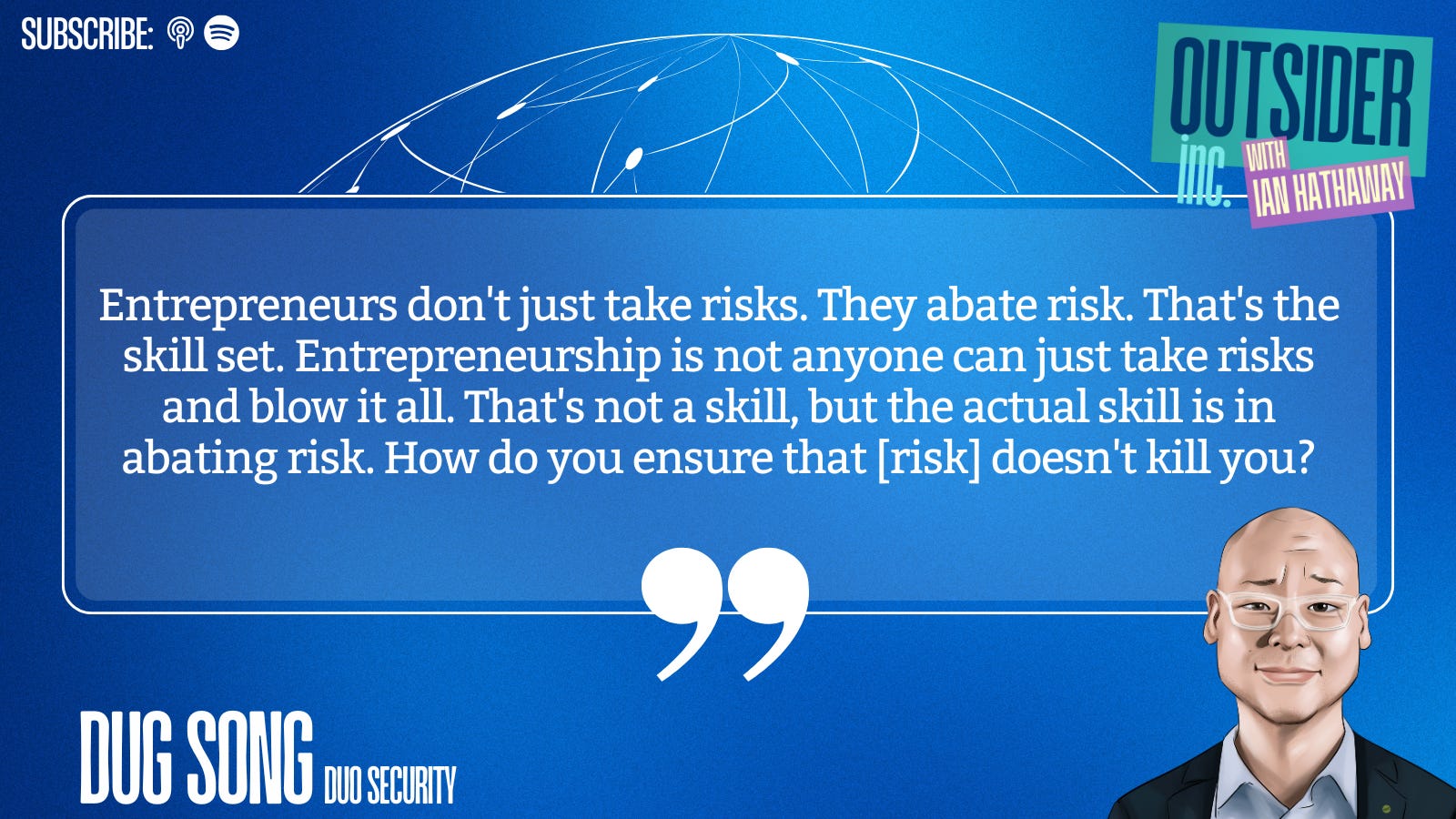
The latest episode of Outsider Inc. welcomed Dug Song, co-founder and former CEO of Duo Security, and a leader in Michigan’s tech ecosystem. Dug founded Duo in Ann Arbor in 2010 with the mission to democratize information security for businesses of all sizes. He quickly scaled the company to more than $100 million in annual recurring revenue, selling it to Cisco in 2018 for $2.35 billion—the largest tech exit in the state’s history at that time. Then, Dug doubled down on Michigan’s innovation ecosystem through investing, philanthropy, and policy advising. The episode traces Dug’s roots from learning to code at age eight in his father’s Baltimore liquor store, to his community-first ethos born out of the punk and skateboard communities, to his involvement in the legendary w00w00 hacker collective, and beyond. This episode was a lot of fun to record. Tune in now ⤵️.
Listen: Spotify, Apple Podcasts, Amazon Music, YouTube
Follow: LinkedIn, Instagram, X, TikTok
The Tao of Wu
In the episode, Dug discussed his affinity for The Tao of Wu, a New York Times bestselling book by The RZA—founder and spiritual architect of the Wu-Tang Clan. Part memoir, part philosophical guide, RZA blends Eastern philosophy, Five-Percent Nation teachings, Christianity, martial arts, and hip-hop to reflect on seven key pillars of wisdom that shaped his evolution from a struggling youth in Staten Island to one of the most influential figures in entertainment. The book offers a personal lens into how he found meaning and discipline through creativity, knowledge, and spiritual practice.

In our conversation, Dug discussed his belief that Duo’s success was attributable to being built in Michigan—that the unique conditions there were foundational and that the company wouldn’t have become what it did anywhere else. RZA makes the same point about the Wu-Tang Clan’s unique brand of success. Despite the fact that Staten Island had no basis in hip-hop, which originated in the Bronx and thrived in Brooklyn, the “Wu-Tang Dynasty” (referring to the group’s collaborative approach that led to a broad sphere of influence) couldn’t have emerged anywhere but Staten Island.
RZA uses the geography and isolation of Staten Island as both a literal and symbolic foundation for Wu-Tang's origin story. Here are three key concepts around this point:
Isolation as fertile ground: RZA describes Staten Island—nicknamed “Shaolin” by the Clan—not just as a place, but as a kind of creative exile. Being physically and culturally cut off from the rest of New York City gave the Wu-Tang members both freedom and hunger. They weren’t part of the Manhattan industry scene or operating in already-established rap networks in Brooklyn or the Bronx, which forced them to build something of their own.
A unique mix of influences: Staten Island was a strange brew of working-class struggle, street violence, and spiritual searching. Wu-Tang combined gritty street experience with esoteric teachings, kung-fu cinema, chess, and comic books—all of which were absorbed in part because they were not immersed in a scene that dictated what hip-hop had to be. This separation allowed RZA to develop a philosophy and sound that didn't have to conform to industry expectations.
Outsider unity: Because they were from Staten Island—and overlooked even within New York—there was a chip on their shoulder, and a powerful bond among them. They weren’t just trying to break into the industry; they were storming the gates together. That collective insurgency became part of the Wu-Tang identity.
In sum, RZA portrays Staten Island as both a constraint and a crucible. It wasn't a coincidence—it was core to the emergence of Wu-Tang Clan. The book makes a strong case that Wu-Tang could only have been born in a place like that—remote, raw, and ready to prove itself. It’s also an approach that aligns with this show’s theme and is aligned with my views on ecosystem-building more broadly.
Ann Arbor’s Small Giant
Dug also referenced how much he learned about building company culture and with community in mind, not from other tech companies, but from Ann Arbor’s famed Zingerman’s Delicatessen. As Dug described Zingerman’s impact on Ann Arbor and his own thinking, I was reminded of an inspiring book I read years ago that profiles the Zingerman’s story—among other high-performing, values-minded, local companies.
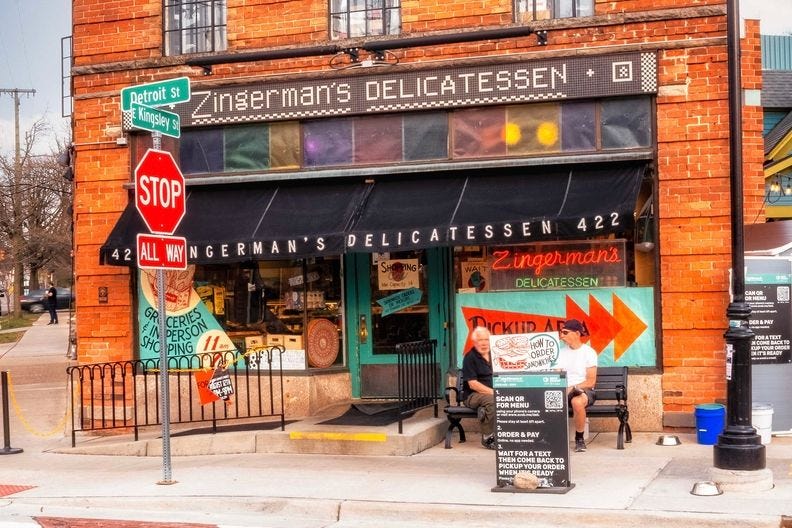
In Small Giants: Companies That Choose to Be Great Instead of Big, Bo Burlingham profiles Zingerman’s not for explosive growth, but for choosing a different path to greatness. Instead of franchising or chasing outside capital, founders Ari Weinzweig and Paul Saginaw built a “community of businesses” rooted in deep values, employee ownership, and obsessive customer experience. Their refusal to conform to typical growth playbooks made Zingerman’s a model for entrepreneurial integrity—proving that staying small can be a form of staying true. It’s a quiet rebellion—and it worked.
Small Giants is a study of successful companies that made a conscious choice: to be great instead of big. It’s a collection of companies led by founders who rejected the traditional growth-at-all-costs path in favor of building businesses that reflect their values, serve their communities, and prioritize craft, culture, and purpose. From Clif Bar to Righteous Babe Records to Union Square Hospitality Group to Anchor Brewing, each story challenges the assumption that scale is the ultimate goal.
What makes these companies compelling isn’t their restraint—it’s their intentionality. They’re deeply profitable, often beloved institutions in their communities, and they’ve found ways to thrive without outside capital, high-growth mandates, or compromising their mission. Small Giants shows that success can come from focus—from doubling down on what matters most rather than chasing what matters to others. Even in the hyper-growth world of tech startups, the lessons from these stories are plentiful.
Episode Highlights
Below are some of my favorite moments during the episode with Dug Song. Here, he describes the fulfillment he receives from sharing the fruits of his work for the benefit of others, the joy he experiences from seeing others do well—”Mudita”—and his role as a “steward” for helping to create a new generation of builders.
And second, Dug talks references The Tao of Wu, and the unique factors in a place that can combine in unexpected ways to produce original forms of creativity—tying that back to Duo’s success due to the unique factors in Michigan’s ecosystem.
I was deeply inspired by my conversation with Dug. What stands out to me most is his insistence that building a company should also be an act of public service. Whether it's mentoring founders, shaping policy, or investing in Michigan’s economic future, Dug has stayed relentlessly focused on using entrepreneurship as a tool for inclusion, justice, and long-term value. His legacy won’t just be measured in wealth generated or jobs created, but in the people and ecosystems he’s lifted up along the way.
“When faced with two choices in life, do whatever makes for the better story” - Dug Song
Up Next
Tune in next week when we’re joined by Shegun Otulana, the founder and former CEO of TheraNest—a vertical software platform for mental health practices he scaled from Birmingham, Alabama to a $1.2 billion acquisition by KKR. Shegun didn’t just build a billion-dollar company—he built it with intention, grit, and humility. He’s now backing the next generation of entrepreneurs through Harmony Venture Labs. Shegun’s story is as much about what he built as it is with how he built it—with clarity of purpose and a deep respect for people that shaped every decision. It’s a powerful reminder that building a great company isn’t just about what you do, but who you are. I look forward to sharing this with our listeners. Tune in next week.