


Listen on: Spotify, Apple Podcasts, Amazon Music
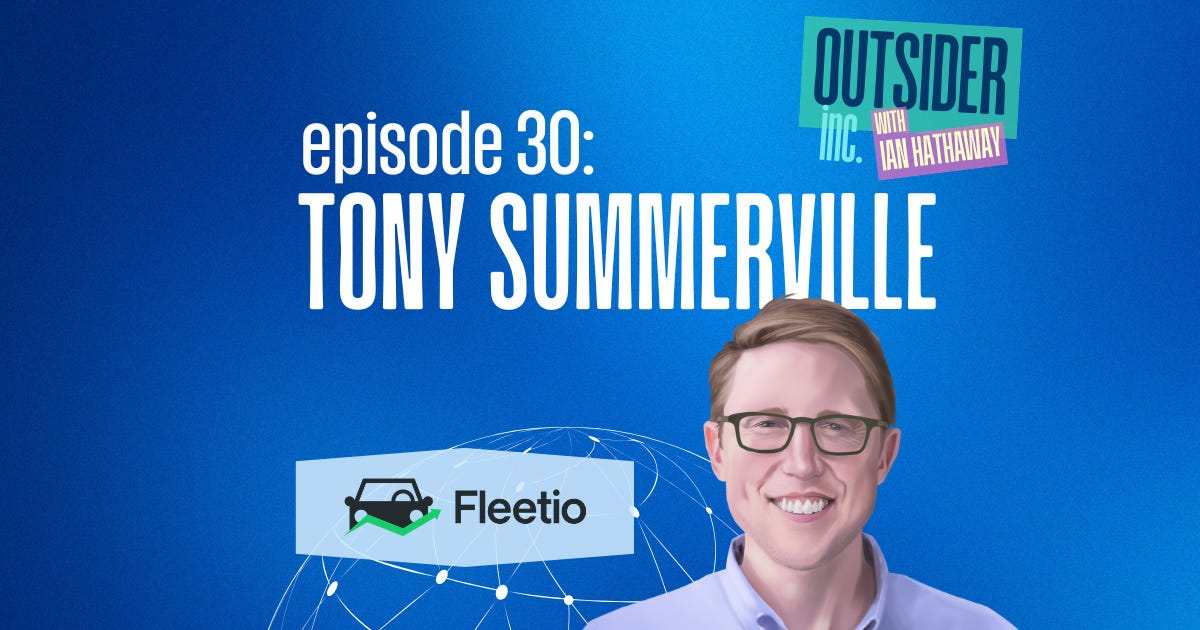
Host Ian Hathaway interviews Tony Summerville, founder and executive chairman of Fleetio, about building a $1.5 billion fleet optimization platform from Birmingham, Alabama. Summerville traces his Huntsville upbringing, summers spent working in his father’s electrical supply business, competitive swimming background, early career at Regions, and time at Daxko, where he saw the shift toward web-based software and learned how SaaS businesses are built. After leaving a stable job with a one-year agreement with his wife Brittany, he spent months interviewing customers before writing a single line of code, using those conversations to validate fleet management as a painful, underserved problem. He describes Fleetio’s early product discovery, the whiteboard moment that shaped its direction, capital-efficient growth, content-driven marketing, the discipline of building before chasing investor validation, and the difficult decision to kill a product that was pulling focus from the core business. They cover the transition from founder-CEO to executive chairman, scaling Fleetio while preserving culture, building from Birmingham, hybrid team design, supporting the next generation of local entrepreneurs, and the personal framework that helped him decide to start in the first place.
Show Notes:
(02:33) Huntsville Roots And Early Work Ethic
(08:43) Leaving Daxko And Taking The Leap
(11:53) Customer Interviews Before Code
(15:22) The Whiteboard That Became Fleetio
(20:19) Bootstrapping And Capital Efficiency
(22:52) The Wrong Kind Of Validation
(24:05) Killing A Product That Half Worked
(29:15) Knowing When To Step Aside
(35:34) Building From Birmingham
(39:44) Investing Back Into The Ecosystem
(43:56) Beyond The Bio with Tony Summerville
✅ Host: Ian Hathway - Co-Founder & Managing Partner, FOVC
✅ Guests: Tony Summerville - Founder & Executive Chairman, Fleetio
Produced by Spellbinder Media. Executive Produced by Bridge Five Ventures. Copyright ©️2026, Bridge Five Ventures, LLC, All rights reserved.
Listen & subscribe wherever you get your podcasts or at outsiderinc.substack.com.
AI-Generated Transcript
Tony Summerville: What I saw in others that I didn’t necessarily agree was, the most fruitful use of time was like to constantly be fundraising, looking for some silver bullet, some investor that’s gonna give you money and, oftentimes validate your idea, because they gave you money. But that’s just the wrong kind of validation. You still have to go build a great business. And then, it’s funny how it works out when you build a good business, people will throw money at you.
Ian Hathaway: Welcome to another episode of Outsider Inc. I’m your host, Ian Hathaway. Today’s guest is Tony Summerville, founder and executive chairman of Fleetio, a fleet optimization platform built in Birmingham, Alabama that recently reached a valuation of more than one point five billion dollars. But Tony’s story starts long before Fleetio. He grew up in an entrepreneurial family, spent his summers working in his father’s electrical supply business in Huntsville, and developed an early understanding of how real operating businesses [00:01:00] work from the inside, the kind of understanding that most software founders simply don’t have. Later, after Auburn University and an early career stop at a regional bank, he made his way to Daxko, one of Birmingham’s early SaaS companies, where he learned not only how software businesses are built but what he might do differently if he ever built one of his own. In 2011, Tony quit his job with a one-year agreement with his wife Brittany and the belief that he could tackle a massive underserved market. What followed was a founder journey defined by disciplined customer discovery, capital-efficient growth, content-driven marketing, hard product decisions, and the difficult transition from doing everything himself to building a company that could scale beyond him. Today, Tony is no longer the day-to-day CEO of Fleetio, but he remains deeply connected to the company’s future and to Birmingham’s next chapter. He and Brittany are now helping support Birmingham AI as it grows from a grassroots meetup into a [00:02:00] structured nonprofit aimed at making sure the city is ready for the next major platform shift. And he’s betting on the next generation of Birmingham entrepreneurs through capital, connections, and mentorship. I’m looking forward to talking about what growing up inside his father’s business taught him, why he spent months with customers before writing a single line of code, how Fleetio found growth in an overlooked market, what it takes to let go as a founder, and what building outside the traditional tech hubs can give you that you might not get anywhere else. Tony, welcome to Outsider Inc
Tony Summerville: Thank you very for having me Ian.
Ian Hathaway: You have an amazing story. I can’t wait to dig into it all. Obviously the centerpiece of this discussion will be Fleetio, but before we get to that, I wanna start with the world you grew up in. Your dad and both of your grandfathers started their own businesses, and you spent summers working in your father’s electrical supply business in Huntsville, stocking heavy supplies in [00:03:00] Alabama warehouse heat, and occasionally driving vehicles out to contractor job sites. Outside of summer work, you were a serious competitive swimmer, ranking fifth in the nation in the 100-meter freestyle at age 10. Well done. A lot of people have summer jobs or childhood sports, but not everyone grows up around entrepreneurship or self-measured competition at that level. So what did those two worlds teach you about hard work, and how did they shape the kind of founder that you eventually became?
Tony Summerville: I’ll start with the swimming. That was just a sport I was drawn to. In Huntsville, where I up, there’s a pretty large summer swimming culture. Pretty much everybody swims on their summer swim team, and I just started doing it year-round at a relatively young age. But I think you’re always just to some degree competing with yourself always trying to improve your time. The outcomes are largely dependent upon the work you put in. And swimming and similar sports teach you, at a relatively young age how to [00:04:00] grind. As you sort of get into the pre-teen and teenage years in a sport like that, I was swimming before school at 5:00 a.m., multiple times a week pretty much every day after school, Saturdays. And so, you sort of learn how to, work hard, how to wake up and do something you’re not really excited to do every single morning. Swimming, I think really at the end of the day taught me how depend on myself, know that I could work hard and grind more or less. Growing up In a family where there was an entrepreneurial father a- and entrepreneurial grandfathers. I saw what my dad not only did every day going into the office, but, he was always at night going through the books. And even on, Sundays too, he would go in pretty much most Sundays. As I got older, I would go to the office with him and, bring my skateboard or my bike and kind of mess around in the warehouse. Probably at a very young age, started learning how to drive a forklift ‘cause it’s just something to do. I think what I got to see was the work effort it truly takes to build something. And I think a lot of entrepreneurs, business owners there’s a lot of work that people never see, and certainly those are some of the [00:05:00] things that I took forward with me, knowing what it takes when I was building Fleetio. I think the other thing that I didn’t realize it at the time, but now reflecting back I think I realized how important an entrepreneur is for the community. Dad built a business and still runs it to this day. There’s, I don’t know, 700 or 800 employees there now. And it is a wonderful culture, really sort of family business, very earnest people, and it’s important, to everybody that earns a paycheck there and their broader families. And I think I felt that at an earlier age seeing how important, Dad was in not just building a business but being an important part of the community and now communities as they’re in many states and, just what that responsibility entails. Those were some things I got to see behind the scenes just growing up in a family like I did.
Ian Hathaway: Being a part of the community, I know that’s a big part of what you’re doing now. We’ll get to that a bit later. Continuing on that theme of hard work, you eventually attend [00:06:00] Auburn University, graduate in 2004 with a degree in information systems, and you take a first job at Regions, a large corporate bank, which by your own account taught you pretty quickly that’s not the environment you were looking for. I heard a story that a big turning point for you was the day that you first saw Google Maps, and you were blown away by it, and you’re kinda looking around the office and nobody else seemed to care. And that was a catalyst for you a moment where you started thinking about doing something different. So what did that moment clarify for you about the kind of environment that you wanted to be in? And then what made Daxko, which was a relatively early-stage SaaS company right there in Birmingham, what made that feel like the right next move for you at that time?
Tony Summerville: I would classify myself as a pretty curious person. Curiosity plus sort of interest or passion is important, and I was just never super passionate about school. One of the things that was somewhat of a [00:07:00] turning point was after my sophomore year I was not excited about going back and working in the very warm hot, muggy warehouse at my dad’s company. And so I kinda walked in one day to the co-op office in the business school and found myself that next summer working at a paper mill in Brewton, Alabama, of all places. Very small town, just north of the Florida Panhandle. What was neat about that experience was I realized what I enjoyed was actually working, and I enjoyed, putting effort into something and sorta seeing results manifest in more reality versus kind of a score on a test. I got a lot more exposure to programming in that job at the paper company, and you could build these little internal, visual Basic apps and things like that. Got some exposure to programming, fell in love with ended up having my first job doing sort of web development. And that’s what I was doing at Regions. What I realized your point about the Google Maps and just really that Web 2.0 era, I had all this context of the challenges of managing a large operation, a giant paper mill, and [00:08:00] the amount of client server, computational effort it took to run something like that. And you could just see, Google Maps, it was a true application feel, but it was like the website was the application. That was just a major stopping point like, this is gonna be important. And so that led me to Daxko because it was a true tech company, a software company that was building a software application. And this was before, software as a service, that, phrase took off. We were calling it on-demand software because it of lived in the cloud and you used it on demand. But again, those few years there where things like Google Maps show that you’re gonna be able to build really impressive, application caliber things in the web. And then my years at Daxko, I mean, that was what we were doing i- is building software that was delivered, over the web and not done, via the traditional client services. So all those things helped me feel the major shift that was coming.
Ian Hathaway: So you spend about six years at Daxko moving through roles as software engineer, new market [00:09:00] strategist, where you were able to work directly with the CEO on an acquisition before finally ending up in product management. A lot of seeds were planted there for what would come next. But I know that also by your last few years at Daxko, you were increasingly trying to tinker on the side, working nights and weekends, getting up early. You came to realize along the way that you couldn’t actually validate a real business idea without being able to go out and talk to customers during real business hours. You had to let go in order to pursue a new business idea. So in the summer of 2011 you quit. You and your wife Brittany, who was also working at Daxko, had an agreement that you’d give it a year, and she’d keep working, she’d have the income, you’d go out and build, and if it didn’t work out, you’d just go back and get another job. Founders realize that they have to be all in, but also have personal [00:10:00] responsibilities to manage. What was it like to walk away from a stable career without the company even being fully formed yet or even having a, a full idea, just with this conviction that you needed to go and find it? And what do you recall about those discussions with your wife about the decision to go all in?
Tony Summerville: She saw it progress, over the course of years, just wanting to strike out on my own and try something. I was approaching the age of 30, and we didn’t have kids yet. It was a moment in time that was as good as it was gonna get as far as the timing aspect. one of the things that was also helpful for me, and I’ve certainly, tried to convey this to others that are thinking about making the jump into entrepreneurism is regret minimization framework. Fast-forward to the future. In my case, looking back as an old man, what am I gonna regret? Most of the time, people regret not trying something [00:11:00] way more than they regret trying and failing. And that’s exactly what ultimately motivated me, was, I would much rather be later in life looking back and have tried something and it not worked out not trying at all. And that ultimately is what, helped me have the confidence to go and, like you say, quit a good, stable job and forge ahead with this. Really kind of had a few ideas, but, none of them were necessarily gonna be the one. But I knew I needed to go out, talk to people. I need to devote, every ounce of my being to this and, give it a real effort. and, all those things led me to have the confidence to just go and do it
Ian Hathaway: The regret minimization framework. Which I guess in this context could be the pain of opportunity versus the pain of regret, which is really about short-term pain, long-term gain. That’s a great Way to view it. So timing is everything. When you quit, I know fleet management wasn’t necessarily the only idea on the table that you were exploring. It was potentially the one with the most opportunity [00:12:00] and one that you had a strong connection from your upbringing. But before you built anything, you spent, three or four months almost entirely on customer interviews. No code, just conversations. You used Eric Ries’ The Lean Startup as your guide, creating one-pager interview sheets and turning those into strategy documents. I know you’ve talked about how if people wouldn’t respond to your outreach or wouldn’t meet with you, it was something that you could treat as a signal. Maybe the problem wasn’t big enough to build for. So at that time, if you could go back, what were you actually trying to learn in those conversations? And what would have made you walk away from an idea entirely?
Tony Summerville: I was looking for a problem that people truly thought was like a top 10, if not a top five, maybe even in certain days the top problem that they would have. And then I was also looking for a way to get customers in a scalable [00:13:00] fashion, are people, one, willing to admit or do they believe that this is a problem? And then If I’m talking to you, Ian, would I even get you as a customer? Are you looking for this, solution to this problem actively? Do you visit, do you talk with, peers that have similar type companies that you might get advice from? And ultimately at the end of the day that, framework level of thinking is do you have a problem we’re solving and do you have a potential go-to-market strategy that can acquire customers and get distribution? ‘Cause at the end of the day I think you have to have a great fundamental, product or solution to a problem. You have to have great distribution. And when I was having a lot of those conversations, you’re obviously putting on the product manager hat and trying to figure out , how you do this, show me your computer. I’m a big believer in just having those conversations if you can, in When you go into somebody’s office you immerse yourself in their full experience and you can sort of see, what’s happening. And in the world our customers their phone’s ringing, their cellphone’s going off, there’s sticky notes, in a lot of places. And it’s not all just about fleet management, but it helps you kinda [00:14:00] understand them ‘cause you’re trying to get in their head. And then you’re also trying to understand in a broad category like fleet management, what are the things that you actually feel like, you need to solve today or like what’s kind of a weekly problem that you wish you could, have a better solution for? And then, how do they describe it? What are the words that they use? Because at the end of the day, we need to make sure that our marketing, is using those same words too so that we show up in, back then, Google search results. You’re just, listening, documenting these things as best you can. But you’re gonna use those insights to hopefully dial in what you need to build and how you need to build it. So all those conversations were important to, zero in on, is this a pain point worth solving? And that starts with will people even respond to me? Because people vote first with their time. And then later hopefully you can get them to vote with their wallet. And it also just, you either decide whether or not you want to build this product and this company. Like, do you want to serve these people? There’s a lot of things that I like and I’m passionate about. There’s a lot of things that I probably, would have a hard time caring deeply about. Are [00:15:00] these the people I wanna spend time with, and do I want to help these people? Not to say that that’s the only thing that matters, but it makes it a lot easier to build something that’s gonna be very difficult to do if you enjoy being around the people that you want to build for and solve for and all those types of things.
Ian Hathaway: So earlier you talked about being curious, Having these customer conversations, listening for the right cues, seeing the right behaviors, observing the environment, then the passion, Do I wanna serve these people? Do I wanna solve this problem amongst many? I feel like in so many of these founding stories, along with that comes a spark, you have this aha moment where it all clicks. I know that in one of these early conversations, there was this defining story for you from Fleetio’s beginning, when you walked into the office of Kid One Transport, which is a Birmingham nonprofit that transports underprivileged kids to medical appointments, and the operations manager there , who was managing a fleet of, a few dozen vehicles, is using this hand-drawn grid [00:16:00] on a whiteboard and that’s how they were managing their entire fleet for this business, that was their core function, managing a fleet, moving people around. You said that moment told you that this was the problem that was worth solving. So what did that whiteboard reveal that a structured interview or a carefully worded survey might not have? I think this might go a little bit to your point of getting into that environment, getting out of your office and sitting with people. But what did that moment change your understanding of what Fleetio actually needed to go out and solve?
Tony Summerville: People will reveal their priorities or what they care about if you just get to see more of their physical context. And you can spend a little bit more time with them in a more structured, yet still informal environment. Okay, they have a huge whiteboard dedicated to fleet management. May not be the biggest, most important thing that they do all day, every day, but from Patrick, that was the guy that was working there at the time, it’s clearly a big part of his, job because he’s got a huge [00:17:00] whiteboard dedicated to it. It’s not just about figuring out what problem to solve, it’s like how do we build a, as perfect as we can get product that, fits like a glove to them? Of course, you’re never gonna be perfect there, but you at least have a much better understanding of how you’re gonna make something that actually solves the problem for them in their context. ‘Cause I’m not a huge believer of trying to make people change dramatically. Show me what you’re already doing, and let’s go find a way to build something that you can incorporate, pretty easily. One of the nice things about web-based software too, back in the early days, you could instrument it with analytics and start to see what are people clicking on? How are they using it? And if you can find usage and people are continually using something, that inherently probably has some value. Hopefully then they’re willing to pay for that usage because they’re getting value for it. Started meeting with Patrick regularly, starting to build things, and you could watch him start to use it more and more and more because it was starting to solve not just solve the problems, but solve it in a way that he could actually use it and start to get value and, stop using the [00:18:00] whiteboard and start using Fleetio.
Ian Hathaway: As you were evolving on these, the shape of the early product, you actually started building it. You get a working version in early 2012. A few months in, you were still the only employee doing everything. Development, sales, support, doing it all yourself. What strikes me a bit about that solo stretch is just how much of what Fleetio still runs on today was figured out during those early trial and error months. Important lesson for founders , think first, don’t just build right away. So when you look back at that period of really experimenting your way into the business, pricing, positioning, how you’d reach a market that didn’t know that software even existed, what’s the lesson that stuck with you most about how you actually figure things out when there’s no one there to tell you the answer?
Tony Summerville: I think one of the, constraints that, just being me for a while was just to [00:19:00] try and, stay focused on a very fast learning loop, and using data, pretty early. And then always looking for ways to kinda automate things. The concept of leverage was just always top of mind to me. So how do I do something once and have it be levered, at least two times or three times or infinite number of times? I, And I was always balancing that to some degree being an entrepreneur there’s not oftentimes the answer in data about what you should do. You have to trust your gut instincts you have to have confidence in your own judgment, and you have to be willing to be wrong. We have made a lot of mistakes and corrected for them, starting in the very early days. You just try to try and figure out are we heading in the right direction or not, and you make little changes oftentimes very subtle. And ultimately, you have to have a mentality of nobody’s gonna tell you what to do. You’re an entrepreneur, you gotta go start building towards, what you think is gonna be a viable solution and a viable market. But then [00:20:00] you are trying to use data to help you understand if you’re heading in the right direction. So it’s like this two-brain thing that you’re balancing. Are we pioneering enough? Are we trusting our gut instinct, moving super fast, and willing to just take risk, constantly? But at the same time too, we’re not just in pure cowboy mode all the time. The other half is being structured. And I think you should probably never really outgrow that. But then you need to have a structured way of deciding was my idea, was the thesis right? And if it is, keep going. If it isn’t, figure out something else
Ian Hathaway: Fleetio bootstrapped for about four years before raising any outside capital. You’ve talked about that period in terms of capital efficiency and being head down, but you’ve also been candid that early fundraising attempts were difficult, And that at some point you felt like it was more productive just to keep building rather than wait for investors to come around. By 2016, the business was growing strongly, and a [00:21:00] Birmingham-based mentor helped lead your first outside round, which was a 750K angel investment. That allowed you to hire a head of revenue for the first time in the company’s history. So if you look back on those early years, how much of Fleetio’s bootstrap DNA was a deliberate strategic choice versus how much was just born out of necessity? And then secondly, how do you feel like that DNA shaped what the company would ultimately become?
Tony Summerville: It was certainly like a fundamental thing that’s driven, the entire identity of the company. And, it’s just so part of the DNA of business. there is no right or wrong way. There’s clearly so many successful businesses or at least software companies that raised a lot of capital, very early on, call it even at the idea phase that went on to great success. But, again, kinda going back to my roots and just growing up around dad’s company and other small and medium-sized companies. had the mentality of build some value first. That’s the number one thing. Like why does the company [00:22:00] exist and how is it actually driving enough value to enough people to where, it’s self-sustainable? I wanted to build something big. And I think my ambition got bigger as the company got bigger and I realized that the potential was even higher than maybe I originally thought. But maybe the entrepreneur in me, I don’t like to depend on other people per se. Like I’m a pretty self-dependent person in a lot of ways. Let’s go build something that we make it or don’t because of our abilities to build and serve our customers, not because we were able to convince somebody to give us money. And so I think looking back, it’s kinda easier to say, I think I felt that. But it was also like it was gonna be a big, challenge to go raise capital at that time. I mean, this was 2012, 2013, the, the venture capital industry was a fraction of what it is today globally and certainly in places like Birmingham it was, basically nonexistent. It was more of a necessity, but I think it, it forced a lot of the right habits and way of thinking about things and keeping the most important thing, the most [00:23:00] important thing, building a business that serves, a collection of people that are willing to pay you money for it. What I saw, in others that I didn’t necessarily agree was, the most fruitful use of time was like to constantly be fundraising, looking for some silver bullet, some investor that’s gonna give you money and, oftentimes validate your idea, because they gave you money. But that’s just the wrong kind of validation. You still have to go build a great business. And that’s the hard part, and that’s what I always just focused on. And then, it’s funny how it works out when you do that and you start to build a good business, people will throw money at you. It’s not hard to raise money once you have established something. And it’s like all those calories you burn just trying to go and raise capital on an idea, again, not saying it’s the absolute wrong way, but it’s putting a lot more emphasis on what are you gonna do? What’s the mission? How are we driving, a great ROI for our customers? How are we getting more customers in a repeatable way? Good distribution channels. Those are the things that consume most of my thinking every day. Because those things started to work, [00:24:00] it was very easy to raise capital.
Ian Hathaway: I wanna double-click on a couple things you said because I there’s an important aspect of the cultural DNA of your company embedded in that. You said keeping the most important thing the most important thing, and you were talking about, at a company level, driving enough value to enough people that the business could self-sustain. Maybe you didn’t write those values down, but you were living them, and I can point to one example in your company’s history, a pivotal moment which I think exemplifies this. Making this tough call, you were building a second product called Fleetio Drive, a smartphone tool that ran in the background scoring drivers. It had traction, but it never really hit the revenue expectations. It was a support nightmare, and it pulled focus away from the core platform. But it was doing enough to provide a defensible excuse for keeping it going, right? What ultimately surfaced the decision to kill [00:25:00] it was something, a culture, a practice you had built into the company early, which was these quarterly strategic off-sites where the leadership team would write pre-read briefs, stare at the metrics, and just be honest with each other about what was happening in the business. You’ve described that cadence as the heartbeat of your company. But here’s what I keep coming back to with this example. You started Fleetio alone in your house, doing every job yourself, which is a lonely way to build. But the off-site that surfaced this, glaring problem in the company was the opposite of that. So I’m curious about those two halves, What does it actually feel like from the inside to kill something that’s half working? And how do you go from being a founder who had no choice but to decide everything alone to then deliberately building a team and a culture and a process that you could trust to make the hard [00:26:00] calls along with you?
Tony Summerville: Going all the way back to square one, which like you said, for about a year it was literally just me, and then for the second year it was just me and another guy named Matt. It was a very small business for a long time. And I think, part of my own self-evolution was growing as a leader and leading others and bringing people kinda into the tent to help make strategic decisions. I would say, my style and definitely a strong suit of mine in building a company from scratch is just being confident enough to make hard decisions. And listen, I was wrong and changed things a lot where I was, pretty confident that I was right and then I ended up being wrong. Three or four years in, we started doing those, quarterly offsites. and I certainly did not want to be ever perceived as or actually making big decisions in a vacuum. And whether or not it was me ultimately making a lot of the decisions, I still wanted to riff with people and have some debate about stuff. I think good ideas come from debate. And that’s where too, I think I had to learn over the years of maybe conveying my thoughts last versus first because as the founder, [00:27:00] oftentimes my words are gonna carry more weight. And again I’m not perfect at this today. I still get overly excited and kind of throw up a bunch of stuff that, I should’ve been more patient with my thoughts. But at the end of the day, I, I cared deeply about building a culture of people who , exemplified our core values and ultimately like they’re here because they’re excellent and they’re humble and they have all these amazing qualities and I wanted their opinions. Even if you didn’t agree with the decision that we made, you saw how I thought about it, you saw how we got to a final decision and, people could buy into it. It wasn’t just ever totally mandated down. But there is still this culture of we’re being thoughtful about everything that we’re doing. Let’s move fast, but let’s be thoughtful and let’s try to, make the best decision that we can implement it, and then decide later if that was not a great decision, we’ll change it. And so specifically with the Fleetio Drive thing, it was like, classic trying to do too much at once. I saw this wave of mobile phones are now like super computers in our pockets and, a big challenge and a big part of the fleet management [00:28:00] industry was like GPS tracking. You physically had to go install a device in every single vehicle to track it. And even then it doesn’t really know who’s driving. It’s just like the vehicle’s on and it’s moving in this direction and so on and so forth. And, I became convinced. I was like, “What if we could just use these cell phones and it detects when you’re driving and it detects, the sort of safety aspects and it could see where it was going and all that kind of stuff?” I was probably overly confident that could work really well. And it was like E-exactly what you described, Ian. It It had customers and it had a lot of interest, and even some really big companies that were like safety focused, but it wasn’t a blowout success. Where You’re just like, man, it’s consuming a lot of time and energy. You gotta focus on scaling the business at that point and I sort of got a little bit starry-eyed with the next thing we’re gonna build and meanwhile the thing that we had built and was growing, for probably a year or two just didn’t get as much attention as I should have been giving it. And all those things came to fruition in these discussions, in these quarterly offsites and some of the data. And then ultimately it wasn’t a hard decision to kill it because we had been [00:29:00] talking about it for a while and then at one offsite we gave ourselves by the next offsite which is three months away, we need to have seen this. Got pretty objective about it. By the time we got to that one we hadn’t seen it and it’s like, all right it’s done. We’re gonna, kill it. But now we gotta work through like we had customers. We couldn’t just shut it off tomorrow. That became a nine-month unwinding it process that still took time too.
Ian Hathaway: Turning off revenue, even if it’s bad revenue, is one of the biggest challenges for any founder or CEO. But you did it. Hard choice at the time, but ultimately it was the right choice. Company continues growing. By twenty twenty-three, Fleetio is more than two hundred employees, customers in over eighty countries. You just closed a big Series C round, hundred and forty-five million dollars. In that same month, after twelve years as founder and CEO, you decided to step down and hand day-to-day leadership to John Meechan, moving yourself to the executive chairman role. That’s a decision almost nobody can make for you, The [00:30:00] company can tell you a lot of things, but whether the founder should still be the CEO is, probably one of the loneliest calls you can make. Flash forward a couple years later, in March , twenty twenty-five, the company raised over four hundred and fifty million dollars in a Series D, made an acquisition of AutoIntegrate with the combined valuation of the company at one point five billion dollars, a chapter that happened with you as chairman, not as CEO. How did you come to know the difference between what Fleetio needed from you as its founder and what it needed from you as its CEO? And then now, watching it reach a scale like it has from the chairman seat, looking forward, what feels most unfinished to you? What are you most looking ahead towards?
Tony Summerville: I think in 2022 especially, I was starting to get pretty burned out. I think the job of the CEO is the job that changes the most. If you just look back over course of 2012 to 2022, that 10-year horizon, what [00:31:00] the company needed me to do changed almost monthly. My work requirements changed dramatically. And I think, what I realized was we had this great business. It’s highly valuable, profitable, and, and doing really well by all accounts. But I think I was realizing that what made me a great entrepreneur I was having to constantly learn how to be a great CEO. frankly, I was at a point where I was considering just selling the business and/or... we’ve always had a lot of strategic potential buyers being in a large industry basically the automotive industry. So we’ve had a lot of really big partners, a lot of big strategic interest over the years. I definitely spent a little bit more time kinda talking to those types of folks and also to some of the large private equity groups to sell a portion of the business. And in 2022, what I really spent a lot of time thinking about was am I done? done? Like I wanna sell this thing and, be, hands off and gone after a year? Or is there still a lot more of the Fleetio story to tell? [00:32:00] Even that word Fleetio, like I vividly remember looking for domain names. Ended up on fleet.io, but I was like in our industry, fleet.io is people think they’re getting scammed or something. But I was like, Fleetio, that’s a fun word, so And I remember like having that conversation, with my wife Brittany in our kitchen. I was like: All right. How does this sound if you were calling in? “Thanks for calling Fleetio. How can...” Th- those are like the sort of fun, fond memories that, every entrepreneur can look back to and remember the really early days of like where things came from. And so as I was sitting there and I was like, I think the Fleetio story has a lot more to be told, but I was like: I don’t know if I the right person to run the day-to-day. I, I started to understand that better was just I spent a lot of time kinda outside the proverbial Fleetio walls talking to not just customers but, other entrepreneurs, CEOs, anybody that I could pepper with questions. And then also like we started hiring more seasoned folks that were coming in from bigger companies. And that was in 2022. Our now CEO, John Meacham, came on as our COO. Started working with him very closely. [00:33:00] And what I started to realize was there are people that can run this company and scale it better than I can. I’m humble enough to realize what I’m good at and what I’m not great at and what I, want to do every day and what the job requires. When you get to hundreds of employees, it’s a totally different ballgame than when you’re like 10, 20, even 50 or 100 employees. so I thought a lot about that. ultimately I told, Jeremiah who leads the firm Elephant, and “Hey I think I’m ready to take a step back and not be CEO, but I wanna fully sell the business.” that was a shock to him by all accounts, the business is thriving, I seem like I’m doing a great job, but I just knew it was the right move and, I also wanted to see the company, grow into what it can become. If you sell a company to a much larger mega company, it doesn’t take a long time, maybe a year, maybe five years, for it to just kinda dissipate into thin air, it just happens. That’s just part of the life cycle of companies. And I just wasn’t ready for Fleetio to just become a part of some other larger company And so, I told Jeremiah in that conversation that there’s a lot [00:34:00] of large private equity groups that are interested. Those folks usually have a stable of But I told him, I was like, “I think John Meachen can be an excellent CEO.” and fast-forward a few more months Jeremiah and his team agreed, and they were, convicted and had seen Fleetio’s growth since 2020 when they first invested and saw the potential of what we could do. Ultimately they came with an offer to, buy more of the company from me. And also again we did a large tender offer to our employees and let them sell some shares. We added some more cash to the balance sheet for sure too. And we had a lot of conversations with John. I flew to Austin and took him to dinner and told intentions of stepping down, he could be a great CEO. He was floored and shocked and it was unexpected. And he decided that he was ready for the challenge and wanted to take it on. Been three years now since, I took a step back into the chairman role. I pinch myself most days that it’s all worked out this well. We’re way bigger than we were back then. There’s always little bumps and things like that, but the business is thriving. We’re doing [00:35:00] incredible things. We’re still Fleetio. We’re still this independent company. We still have the same culture. It’s just scaled and it’s evolved. But I couldn’t be more proud of how things have gone. And, for me, it’s taken some work just to find the right sort of balance of where I insert myself, I’m still the founder of the business. I’ll always know more about the history than anybody. But it’s been so awesome to witness John just really thrive as the CEO and come into his own and build his exec team and just take the business to what I knew it could become and even bigger than I thought it could become. And there’s, no end in sight. So it’s been a fun journey.
Ian Hathaway: It’s a great story. To make the decision you made. It’s not easy. Many founders choose to not make it that easy, right? But you did, and it’s working out. I’m happy for you. I’d like to switch gears if we could. Quickly, I wanna talk about Birmingham, Big theme on this show is what it takes to succeed entrepreneurial ecosystems outside the traditional tech hubs. Obviously, your story speaks directly to that. But what’s [00:36:00] also interesting is that a lot of our guests have made the case that the constraints of building in a less mature ecosystem actually made their companies stronger, more resilient, more creative. That what’s perceived as a weakness in these ecosystems actually over the long term turns out to be strengths including Segun Oyelana, who is your, friend and neighbor in Birmingham. And, some of thinking is clearly visible in how you built Fleetio. So I guess I just wanna hear it from you in your own words. What has building in Birmingham actually been like for you? The real advantages, the real disadvantages, and how much of how you built Fleetio do you think was shaped specifically by where you built it?
Tony Summerville: This one goes back to timing as well. I think one of the things back in 2011, 2012, I had a real conviction that you could build a great business anywhere. I was at Daxko, which was a large success. It was a, pretty much [00:37:00] Birmingham-based business that had maybe a couple of like, remote or distributed sales team members, but everybody was in the office each and every day. And we had some incredibly talented people there. Birmingham’s a bigger city than maybe people realize because when you count all the municipalities around it, it’s l- well over a million people roughly in the area. Companies are a collection of human beings that are aligned hopefully on a mission and vision, and they bring their skill sets and talents to achieve that mission and vision. Shegun and others shared the same mentality. And we were all at this place called the Innovation Depot. It’s the perfect storm and a good way us all trying to build great companies out of Birmingham, knowing that the talent pool here is, limited. Shagan and I shared a lot of the same conviction. And then we started to do it, and we had, learnings we could share with each other about how to build and, attract talent and build a culture that everybody feels like they’re still a part of a great company and a great team, even if everybody isn’t all in the same place at the same time. I think the Birmingham [00:38:00] connection was always, and still is very strong. We’re proudly headquartered here. We have an amazing office. and we always had this like hybrid, culture where we always had a relatively high percentage of distributed team members, starting with the third employee, George, who’s still our CTO today. Once he came on board, we were 33% distributed. But over the years we were very intentional. George, when he first started, he came and joined Matt and I for the first probably week or two in our closet-size office in the Innovation Depot. And for years, I mean, all those first, distributed employees, really up until COVID, you would come and spend your first week in the office in Birmingham. And we always had a lot of our sales team in, in Birmingham. We built out certain departments and roles here. But we’d always bring people here early and often to be a part of the team and get the physical, aspects of being around one another. What we learned, and I think what a lot of people learned, is if you balance the right like, yes, people need to be together, and yes, there’s a lot of creative work that [00:39:00] is so much easier when you’re in person, but then there’s a lot of just work that happens each and every day. No matter what kind of company you’re in and what sort of job you have, especially in knowledge work. And there is a lot of value in just having people be distributed and being able to focus, create a comfortable environment wherever they are. But if you can create a great culture with, that’s a hybrid of virtual and in-person and team members, then you get to hire the best people. Like you get this talent pool that’s, infinite. And that’s such an incredible way, I think to build a company. And I think, Fleetio, Shagun’s business, plenty of others that saw that opportunity ahead of others and leaned into it and built intentional sort of hybrid cultures. There’s a reason I think we’ve all had outsized success.
Ian Hathaway: That’s a theme that has appeared on this show multiple times about how do you build, how do you scale in a less mature ecosystem? So I, I wanna ask kinda one last major question here, which is, y- look, Tony, you grew up watching your father build a business, spent your summers [00:40:00] stocking supplies in a warehouse, and built Fleetio from an idea into a billion-dollar platform from a place most people would not have bet on. And now you’re putting your time, your money, and your credibility into making sure the next founder from an overlooked place gets a real shot. So if you could imagine, 20 years from now, looking back on all of it, what do you hope you’ll have proven about what’s possible for solo founders, for founders building something lasting for a customer base that the rest of the industry has overlooked, and about scaling a platform in a place that most VCs would never consider?
Tony Summerville: I, I’ve always loved that phrase, if you can see it, you can be it. Human beings are oftentimes, either intentionally or, even subconsciously inspired by others that they can witness do something. And for me, I think I certainly have benefited from learning about and [00:41:00] witnessing others, achieve success. And to me it’s not just about the business success. Like I’ve always gravitated towards others that their whole self, their entire way that they carry themselves, the way that they treat others the way that they treat their families, treat everybody around them and also have, success and take risks and see things through. And for me I love Birmingham. I can’t imagine having done this in another place. I have, two sons that are now entering the, teenage years soon and first and foremost always try to be a role model for them. A- and then, for others there’s plenty of great talented entrepreneurs here in Birmingham and in other places. We care deeply about this ecosystem and always try to be an objective investor. I’m a capitalist at the end of the day. I want to see, investment dollars go into something that can drive value and a return. And so when we’re looking at, startup investments, that’s certainly part of it. But we try to have a not just, ability to invest in the early stage companies and I know you know some of the, folks in and around the Birmingham [00:42:00] ecosystem that, that we’ve gotten involved with. But, I think it’s fun to see others on the same journey or a similar journey that I’ve been on. And, you know, the one thing I think that I’m pretty confident in is that there’s no perfect answer. There’s no silver bullet that’s gonna solve everything and also there’s so many other aspects to success than just the business side. But what I definitely enjoy is being able to share my story, a- and thank you for hosting me here today, doing it, on a more individual basis, especially with local folks that we wanna see be successful too. And just helping them think bigger, think about, the opportunity set that they have. Being able to challenge people, but, from a place of love and respect and making sure that they’re thinking about all aspects of what they’re trying to accomplish. when I look back, hopefully success to me would be that as my sons get older and, certainly I want them to figure out what’s right for them as far as where they go to school, where they end up in their careers. There’s a lot of us that are in Birmingham that love it here and want to see our [00:43:00] future economy continue to, grow and thrive, and that means, more jobs more opportunities for people to have great careers here, more restaurants, more things to do. And I think at the end of the day that just takes more and more entrepreneurs whether you’re building the next tech company or you’re gonna start a great restaurant or bar or do something kinda off the beaten path. and I just love supporting and being, the biggest cheerleader for entrepreneurs, especially in, , where I live
Ian Hathaway: Well Said. Birmingham is a fantastic place. The ecosystem is strong. The people who have had kind of the breakout successes in the Birmingham tech ecosystem are all relatively young and very engaged in building the ecosystem for future generations that they might have a easier time than they had. I will triple click on the restaurant vibe. The biggest challenge when I come to Birmingham is deciding where to eat because there’s so many great restaurants. And hopefully I have a chance to do that here in a [00:44:00] few weeks. So that’s a great way to end. But before I let you go we like to finish with a segment called Beyond the Bio. These are just some quick hit, questions that let us step away from the resume and dig into what makes you, you. Sound okay?
Tony Summerville: Let’s do it.
Ian Hathaway: All right. What’s a quick piece of advice from a mentor that stuck with you throughout your journey?
Tony Summerville: Had some good advice from a couple of different folks that have just reiterated how you make people feel is what you leave them with, and whether that’s a conversation or more broadly, how you make people feel is probably most important
Ian Hathaway: No one remembers what you do, they remember how you made them feel. Who is an unsung hero in your life and what has been the impact they’ve had on you?
Tony Summerville: Beyond just being an incredible wife, my, my wife Brittany has been joined at the hip with me, proverbially for this entire journey. She supported me and this, taking the leap. And, she in her own right, successful more on the, customer service side of things. And still to this day, just enjoy [00:45:00] her advice and discussion around, all things Fleetio over the years. And now, in the phase that we’re in, just being able to invest and even, on the philanthropic side she’s just such a, a great partner for me over the years.
Ian Hathaway: Who’s someone in the Birmingham startup community who doesn’t get enough credit and deserves a shout-out?
Tony Summerville: He recently did a podcast that I thought was great. But Jared Weinstein is a spectacularly successful individual that grew up here in Birmingham and had an incredible career both working very closely for George W. Bush and then essentially co-founding Thrive Capital. And now he’s on kind of his next act. But he has his, fingertips on an enormous amount of things in Birmingham and is a real just incredible driver of the community, but really is pretty under the radar considering his accomplishments and his stature.
Ian Hathaway: You’re the second Birmingham founder to come on this show and the second to name Jared for this exact question. Tell us something most [00:46:00] people don’t know about you. Something outside of work, could be a hobby, a favorite travel spot, a guilty pleasure, or maybe even a hidden talent.
Tony Summerville: Most people know that I hate onions. If you’re around me and we ever eat I cannot stand onions. I’m the annoying person that always asks for no onions on everything every time we go out. But luckily my wife is the same way so we bonded when we were dating on the no onion thing.
Ian Hathaway: Oh, that’s amazing. I was not expecting that. Okay. What are one or two songs you’d like to add to our Spotify Founders playlist? Something that fuels your workday or has maybe inspired you on your journey as an entrepreneur
Tony Summerville: I’ve listened to so many things over the years as I was building Fleetio in different phases of life. I’m still probably just like an indie rock, person, things like The Strokes and maybe even some electronic indie rock like Management.
Ian Hathaway: That’s great.
Tony Summerville: I I know I’m getting old though because I used to not really like country music. My dad always liked it, and he’d have it in the car, and I just, “Ugh, I just don’t...” [00:47:00] But now I’ve I listen to a lot more country than I did back in my earlier days. Big Chris Stapleton fan
Ian Hathaway: Oh, yeah. My favorite Star-Spangled Banner from the Super Bowl.
Tony Summerville: So good. So good
Ian Hathaway: What’s a book you’d recommend? Maybe something that’s been especially valuable in your own journey or one that you think every first-time founder should read as they’re getting started
Tony Summerville: My favorite business relevant book is “Shoe Dog,” the Phil Knight about Nike. I’ve read it multiple times, listened to it. It’s a great audiobook if that’s more of your flavor. That one is really good. Another book that I keep a lot of copies of and I give out to a lot of the founders that we invest in is Output Management,” which is the Andy Grove book. A lot of people recommend that one. It’s popular in the tech communities, but a lot of people haven’t read it.
Ian Hathaway: We give that same book out.
Tony Summerville: That one’s just good. It’s short. It just... it puts you in a mindset. And then probably the third book that I just find myself recommending for all walks of life and all different categories of future career opportunities is just [00:48:00] old school Dale Carnegie, “How to Win Friends and Influence People.”
Ian Hathaway: Yes
Tony Summerville: books like that, they’re pretty timeless. if you can bake in some of those habits out of those books no matter what you do in life, it’s gonna make you more successful.
Ian Hathaway: Okay, last question. If you could give one piece of advice to someone who’s about to start their first company today, particularly someone who’s maybe a bit of an outsider, what would it be?
Tony Summerville: Well One, I would just say start. I think there’s so many people that I meet that want to start something. And it kinda gets back to that regret minimization framework. Think if you really feel convicted to do something, like start a business, whether it’s a tech company or, a restaurant or whatever there’s never gonna be a red carpet that gets rolled out and invites you to this perfect, situation. There might be some better timing situations than others, but for me personally really good framework for choosing to take action has been that. And then I think if you’re starting a company today I would say spend time thinking. So few people, I get the sense, have given a lot of thought to the question what do [00:49:00] you want? What do you want this business to be? in five years, what do you want your life to look like? What do you want your day-to-day to look like? What do you hope the business looks like? Decide what you want. I think if you can see it, you can be it, and sometimes seeing it is the vision aspect of what do you want to achieve? What do you want your life to look like in five years? And give that some thought.
Ian Hathaway: Yeah, sometimes those simple questions we don’t have answers for. And I like the evolution of this regret minimization framework. At least in my mind, I’m walking away with, would you rather suffer from the pain of action or the pain of regret? so we’ll end there. This was an awesome conversation, Tony. Thank you so much for joining us. I cannot wait to share this episode with our listeners.
Tony Summerville: Thank you, Ian. Thanks for having me. Enjoyed it.
Ian Hathaway: That’s a wrap for today’s episode of Outsider Inc. A big thank you to Tony Summerville for joining us and sharing his fascinating story. What stays with me isn’t the one point five billion dollar valuation. It’s how much of Fleetio was already written in [00:50:00] a Huntsville warehouse with a teen watching his dad go through the books on a Sunday. Tony refused the shortcut everyone else was chasing. No silver bullet investor, no validation borrowed from a term sheet. Just months of conversations before a line of code was written, , a whiteboard at an early customer’s office that told him the problem was real, and the patience to let a good business earn its own capital. And he built it in Birmingham proudly, deliberately proving a billion-dollar company doesn’t need a coastal zip code, just talent and someone willing to bet on a place most VCs would overlook. Underneath that discipline is the humility to admit years later, that the founder who built the thing might not be the one to lead its next phase, and to step back, not because Fleetio needed less of him, but because it needed more of something else. Now, he’s pouring that same belief back into the next generation of Birmingham founders. So take his advice. Start. Decide what you actually [00:51:00] want, and remember that when you build something real, the money will find you. If you want more from Outsider Inc., don’t forget to subscribe to the platform at outsiderinc.substack.com. It’s packed with highlights from today’s episode and bonus insights you won’t wanna miss. You can follow Outsider Inc. on YouTube, Instagram, TikTok, and LinkedIn at outsiderincpod. You can also follow me on X at Ian Hathaway. Outsider Inc. is produced by Spellbinder Media. We’ll be back soon with another fascinating Outsider conversation. Until then, thank you so much for listening, and remember, great entrepreneurs can come from anywhere. See you next time.